Twin Lakes Beach Club
Our History
A lake club since 1925, a beach club since 1948.
-
1925
The Twin Lakes Club
Lake residents met for a corn roast at Roraback’s tennis courts, then turned a converted house on the southwest cove into a clubhouse, on the condition that no liquor was served. Nearly everyone on the lakes belonged.
Read the full account: 1925
“The Twin Lakes Club” served as the predecessor to the Twin Lakes Beach Club. About 1925, residents of the Lakes held a corn roast at Roraback’s tennis courts. The ladies of the east and south shores entertained residents from the west shore. Thereafter, a converted residence at the southwest cove of the lake became a clubhouse, after it was agreed to meet Mr. Mile’s stipulation that there would be no liquor on the premises.
Nearly everyone on the lakes belonged. Members held tennis tournaments on two courts. Members also scheduled Saturday evening summer suppers with dancing afterward, sometimes to a live band. On Sunday mornings there would be a softball game. Teenagers gathered at the Club for ice cream or soft drinks and listened to records of the bands of the era.
-
1940s
The war years
With the advent of the Second World War, ladies met at the clubhouse for Red Cross work. Finally, with so many young men in the service, the club disbanded; the clubhouse became Roberts Grocery Store.
-
1947–48
The Twin Lakes Beach Club is founded
At the end of the War, a group of residents revived the Club as The Twin Lakes Beach Club. They purchased land and a boarding house next to the O’Hara Marina, and converted this property into a clubhouse.
-
1950s–early ’60s
Lean years
Membership fell: the club offered little residents lacked at home, the dues rules changed and costs rose. Buying the neighboring cottage and land, paid for with members’ demand notes, strained the treasury further.
Read the full account: 1950s–early ’60s
The club operated successfully until membership declined in the late ’50s and early ’60s. This happened for several reasons. First, the club offered swimming and boating only (aside from social activities), and the facility duplicated the recreational activities that lake residents enjoyed at home. Second, the club altered its dues structure, charging $10 per person to avoid paying a Federal excise tax on such clubs during the Korean War. Lastly, rising costs and decreased revenue from dues led to the club not being able to meet its operating expenses. This forced the club to invade its capital fund, and to assess members a small amount annually. These actions served only to weaken interest in the club, along with its finances.
One other factor added to the fiscal burden. Around the turn of the decade, the opportunity arose to acquire an adjacent piece of land, complete with its cottage. In terms of adding to club real estate, the purchase was a very good one; however, the Club treasury was in no position to finance such an undertaking. To complete the purchase, the club raised $5,500 by subscription and recognized this obligation by issuing 5 percent demand notes — five for $1,000 each and one for $500.
-
1963–64
At a crossroads: the tennis courts
Facing liquidation, the Board chose to build two tennis courts instead. Dues rose from $10 a person to $75 a family, a membership drive succeeded, and the courts opened for the 1964 season.
Read the full account: 1963–64
By 1963, the Club found itself at a crossroads. Membership had declined steeply and financial reserves were just about depleted. The average age of the stockholders had increased to a point where the majority of them were no longer active members, a situation which promised to make it increasingly difficult to make the sort of adjustments to the Club that would require their approval. The specter of one or more of the demand notes passing into an estate situation haunted the club. (No interest payment had even been made.)
In the fall of 1963, the Board of Governors met to decide which road to take — to liquidate the Club, sell the property, pay off the balance of the mortgage and settle the residue on stockholders — or to find some new way to revive interest in the club by making it more attractive to present and prospective members. Out of this meeting came the decision to build two tennis courts, in the hope that this action would reverse the club’s fortunes.
To meet the initial financing of this venture, the club increased its mortgage to $15,000. The increase came within a few hundred dollars of the cost of the tennis courts. The courts were completed for the 1964 season. To finance this new debt, dues increased from $10 per person to $75 per family, plus a 20 percent federal tax, bringing total dues to $90. The club held a concerted membership drive with highly encouraging results and met its operating budget. A tennis professional offered lessons; the snack bar reopened; the club also refurbished the beach area and completed minor repairs to the clubhouse.
-
1990
The fire
On August 29, 1990, fire destroyed the clubhouse. The season still finished on schedule.
Read the full account: 1990
On Wednesday, August 29, 1990, a fire destroyed the clubhouse. In spite of the loss, the season finished on schedule. Bill Duryee reported, “At a special meeting of the Board of Directors to discuss the burning of the clubhouse, it was resolved that the spirit of The Twin Lakes Beach Club is not one of brick and stone — a clubhouse but one of continuity — a continuity of young and old — present and past — and memories of all.”
-
1991
A new clubhouse
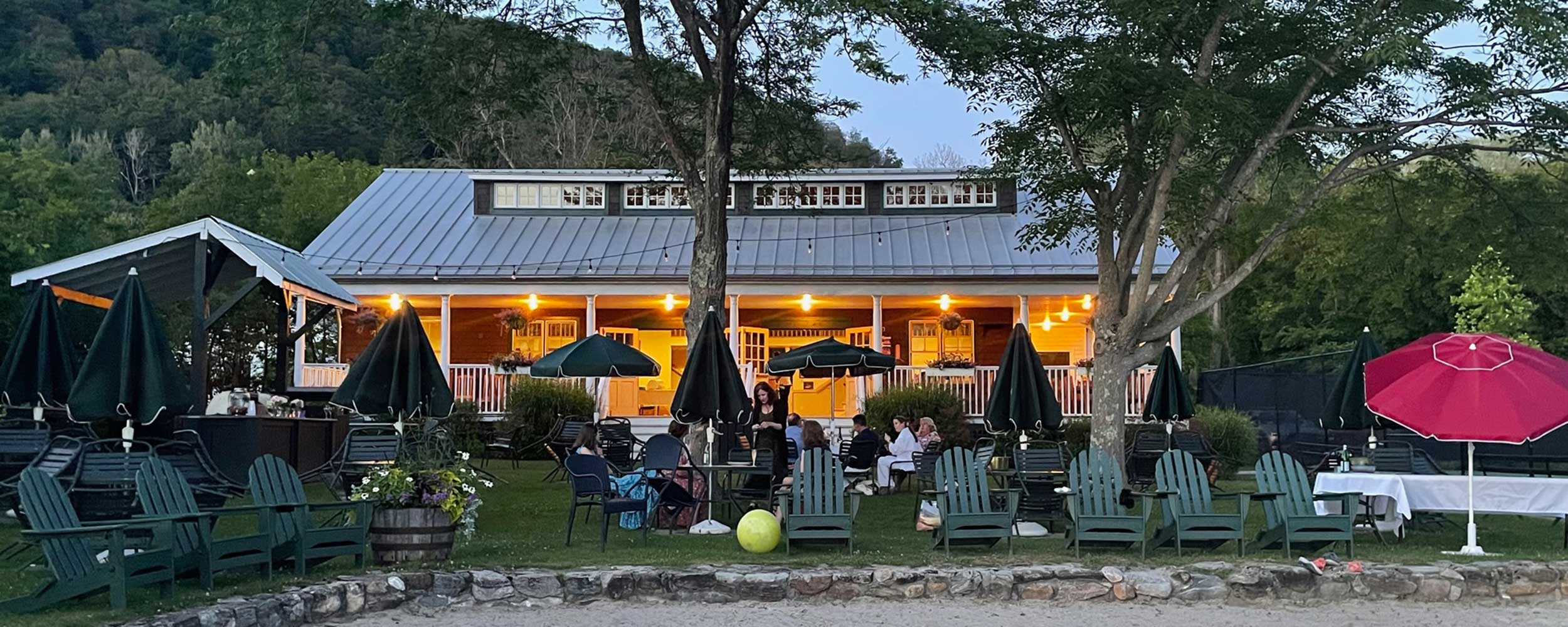
The members rebuilt the clubhouse within one year in order to salvage the old footprint of 4,500 square feet. As a result of an outpouring of support from friends and members, the rebuilding program succeeded, and the new clubhouse, designed by member Donald Blair, debuted for the 1991 Opening Cocktail Party.
-
Today
The club today
Two tennis courts, a groomed beach, and tennis, social and waterfront programs at every level, each with a special commitment to the club’s younger members.
Read the full account: Today
From a modest beach club with no beach to speak of, The Twin Lakes Beach Club has evolved into a well-kept facility with two dazzling tennis courts and a groomed beach. Club activities have kept pace, providing opportunities at every level of tennis play, along with expanding social and waterfront activities, each with a special commitment to the younger member.
Compiled by Judy Mathus, courtesy of Art Wessel and Jack Silliman.
From the club songbook
Three songs written by a member family in 2019, still sung at the closing campfire.
Be part of the next chapter
The club has been member-run since the beginning. Here is how to join.